Every session, price runs beyond a candle's range to collect the orders sitting there, then reverses. The Candle Trap Method teaches you to spot that move as it forms, and to take the one New York gives you first.
Under every clear low sits a crowd of orders: sell stops from traders waiting for the breakdown, stop losses from everyone long above it. To fill a large buy order without moving price against themselves, big participants need that crowd of sellers. So price is pushed through the low, the orders are collected, and with the selling exhausted, price comes back.
From the outside it looks like a fakeout. It isn't random, and it isn't bad luck. It's the cost of doing business for the people who move the market, and it leaves a footprint on the chart that, once you've seen it, you can't unsee. The method is learning to read that footprint.
The move outside the box is the bait. The move back through it is the trade.
No indicators, no multi-timeframe confluence, nothing to install. Three consecutive candles tell you everything: where the trap is, when it's been set, and when it springs. The exact rules are inside.
One candle sets the range the market is about to play with. Which candle? That's the first thing the guide teaches, and it isn't the one most traders would pick.
The market goes fishing for the orders outside the range. There's a precise, one-candle signal that the bait has been taken, and it's the heart of the method.
The trap springs and price reverses through the range. Entry, stop and target are all defined before you click, by the candles you just watched form.
By the time New York opens, the morning has already left orders sitting where the market can reach them. New York's first move usually goes to collect them. That first trap is the highest-quality one of the day, and it's the one you take.
The method is deliberately narrow. You sit down at the New York open, you watch the 15-minute chart, and you wait for the first trap. You place one order. If it fills, that's your trade. If it doesn't, you wait for the next one. Once you've taken a trade, win or lose, you're done.
One session, one trap, one trade a day. It's enough to build the skill, and it keeps you away from the temptation of trading every wick you see.
Twenty-four pages, A4, designed to sit next to your charts. Every rule, every diagram, and the complete toolkit.
The last chapter is the one that ends up next to your charts. It is built to be printed and filled in, not just read.
The method's rules were coded into a TradingView strategy and run over price data that had already printed. This is a backtest, not a trading account and not a track record — and the numbers below include the ugly ones.
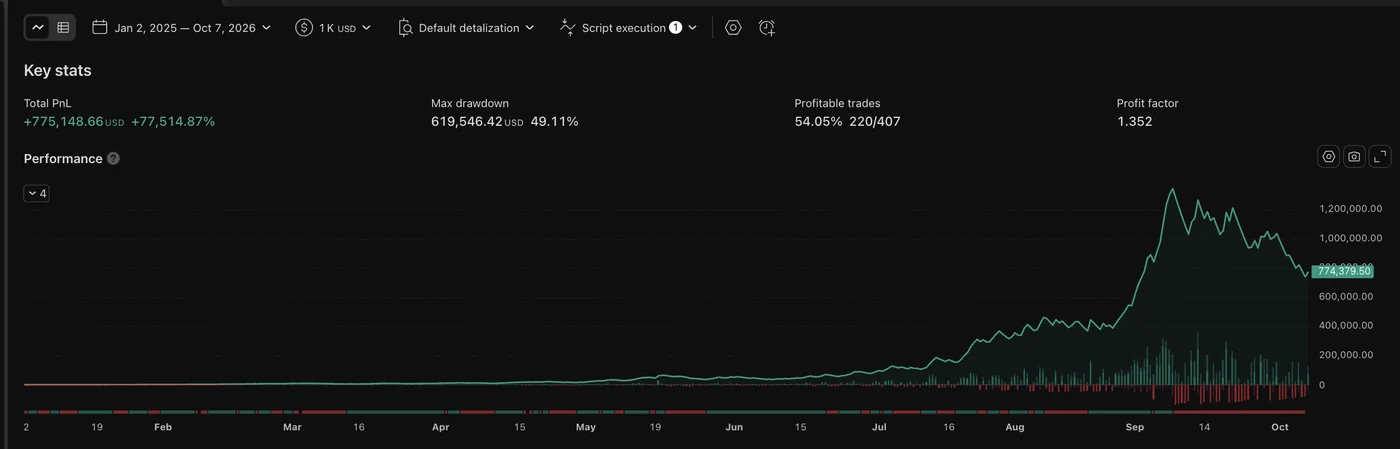
Hypothetical performance. These figures come from a strategy test on historical data, not from a real trading account, and they are not a prediction of what you or anyone else will make. Past performance does not guarantee future results. Trading leveraged products carries a high risk of losing your money. Nothing on this page is financial advice.
You're not buying a promise of profit. You're buying a precise, rule-based way of reading the trap that you can verify on your own charts, in your own time, before you ever risk a cent.
The complete method in writing. Read it in an evening, keep it next to your charts.
Read the guide and mark up a few sessions. If it isn't what you expected, email us within 14 days for a full refund.
Secure checkout. Instant download by email. Trading involves substantial risk of loss; these are educational products and not financial advice.
Yes. The pattern is taught on gold, EURUSD and GBPUSD, and it is the same three candles on indices and other majors. Gold and the majors are used because they are liquid during New York and the sweeps are clean.
Yes, for roughly two hours from 08:00 New York time. That's 14:00 to 16:00 in South Africa and the UK during US summer, an hour later in winter, and the early evening across most of Asia. If you can't make that window, this method won't fit your day.
No. You learn to identify the setup yourself. Nothing is sent to you and nothing trades for you. That is the point: once you can read the three candles, you don't depend on anyone.
No honest method promises a number. The guide explains why a win rate in the forties to fifties can be positive over time when every trade is filtered for a minimum reward, and it teaches you to judge yourself on following the rules, not on single trades.
You need to know what a candlestick is, how to place a stop order, and how to size a position. Everything else is taught from the ground up. If you've never opened a chart, spend a few weeks on demo with a broker's tutorials first.
After checkout you get an email with your download link, usually within a minute. The guide is yours for good, and every future edition is included free.